


Website Development in 2026: What Businesses Should Consider

 Development
A modern website needs to do much more than look good. It should load quickly, work flawlessly on mobile devices, protect user data, integrate with your CRM, and help your business generate leads. That is why website development in 2026 starts with business goals, user journeys, and technical requirements, not with choosing button colors.
The DigiWay team has put together eight key principles to consider if you’re planning to build a new website or redesign an existing one.
1. Performance and Core Web Vitals
Website speed affects user experience, conversion rates, and overall page quality. Google recommends evaluating real user experience using three Core Web Vitals metrics.
- LCP (Largest Contentful Paint) measures how quickly the main content becomes visible. A good result is 2.5 seconds or less.
- INP (Interaction to Next Paint) measures how quickly the page responds to user interactions. The recommended value is under 200 milliseconds.
- CLS (Cumulative Layout Shift) measures visual stability during page loading. A good score is below 0.1.
Core Web Vitals are one of Google’s page quality signals, but they do not guarantee high rankings on their own. Search performance also depends on content relevance, usefulness, website authority, and many other ranking factors.
Improving website speed requires a combination of optimizations. Images should be compressed and, where appropriate, converted to WebP or AVIF. Non-critical JavaScript can be deferred, fonts should be optimized, and both the server and caching system should be configured for real-world traffic. Performance should be evaluated not only with laboratory tools such as PageSpeed Insights, but also using real user data.
2. Mobile-First Design and Consistent Content Across Devices
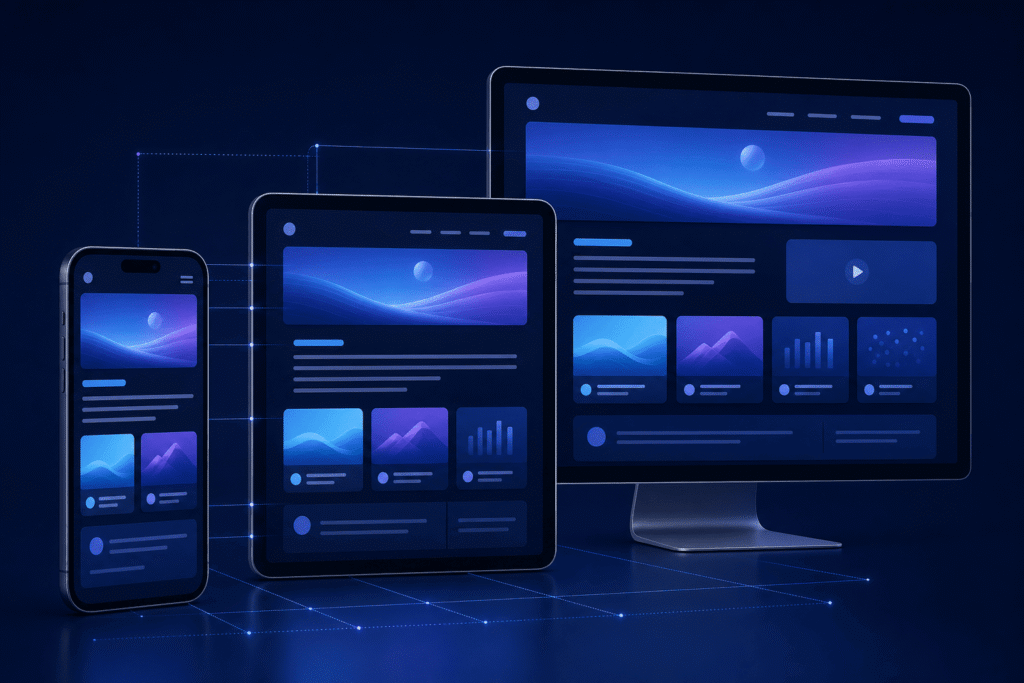
Google primarily uses the mobile version of a page for indexing and ranking. For that reason, the mobile experience should never be treated as a simplified version of the desktop website.
A mobile-first approach means designing the core user experience for smaller screens first, then adapting it for tablets and desktop devices. The mobile version should include the same essential content, headings, images, links, and structured data as the desktop version. If valuable content is only available on desktop, search engines may not take it into account.
When testing your website, make sure to check:
- The main content is fully available on every device.
- Navigation and contact forms are easy to use.
- Buttons and interactive elements are large enough to tap comfortably.
- Text is readable without zooming.
- There is no horizontal scrolling.
- Pages load quickly on mobile networks.
3. Choosing the Right Architecture for Your Business
There is no single technology that works equally well for every project. A corporate website, an eCommerce store, and a complex web application all require different architectural approaches.
A traditional WordPress website is still an excellent choice for many businesses that want to manage their own content, publish articles, and expand their website over time. With a well-built theme, a reasonable number of plugins, and regular maintenance, WordPress remains a practical and cost-effective solution.
A headless architecture separates the content management system from the front end. For example, WordPress can be used as the CMS while the user interface is built with Next.js or Nuxt. This approach is valuable when the same content needs to be delivered across multiple channels, such as websites, mobile apps, or other digital platforms, or when a project requires a highly customized user experience. However, headless development increases the complexity of development, testing, and maintenance, so it should be chosen because the project requires it, not simply because it is a popular trend.
Before development begins, it’s worth answering a few key questions:
- What types of content will the website include?
- Who will manage and update that content?
- What integrations are required now, and which may be needed in the future?
- What level of traffic is expected?
- What are the security requirements?
- What budget is available for ongoing maintenance after launch?

4. Accessibility Matters
An accessible website is easier to use for people with visual, hearing, or motor impairments, as well as for users who rely on keyboards or screen readers.
In practice, this means using a clear heading structure, sufficient color contrast, visible keyboard focus states, descriptive labels for form fields, and meaningful alternative text for informative images. Buttons and links should have clear, descriptive names, and form validation errors should be explained with text instead of relying on color alone.
Accessibility should be considered from the design and development stages. Fixing structural accessibility issues after launch usually takes considerably more time and effort.
5. AI Integrations Should Solve Real Business Problems
AI assistants can answer frequently asked questions, help users choose the right service, collect information before a sales inquiry, or hand conversations over to a member of your team. However, adding AI simply because it is popular rarely delivers real value.
Before implementing AI features, define the following:
- What user problem will the assistant solve?
- What data will it use to generate responses?
- How will the accuracy of its answers be verified?
- When should the conversation be transferred to a human?
- What personal data will be processed?
- How will business value be measured?
AI-powered features require clear limitations, proper error logging, and strong protection of confidential information. An assistant should never promise services your company cannot deliver or present unverified information as an official answer.
6. Security and Privacy by Default
Security should never be treated as the final step of a project. A website should use HTTPS, receive regular software updates, and restrict access to the admin area. Accounts with elevated permissions should ideally be protected with multi-factor authentication, while backups should be stored separately and tested regularly to ensure they can be restored when needed.
If your website serves visitors from the European Union, GDPR compliance and cookie regulations should also be taken into account. In many cases, non-essential cookies used for analytics, advertising, or tracking cannot be placed before the user has given consent. Visitors should clearly understand why their data is being processed and be able to decline or withdraw consent just as easily as they can accept it.
A cookie banner alone is not enough to achieve compliance. You should also verify how scripts behave in practice, review forms and privacy policies, define data retention periods, and check how third-party services process user data. Legal wording should always be reviewed by a data protection professional.

7. Set Up Analytics Before Launch
Analytics should answer business questions, not simply count visitors. Before your website goes live, define the key user actions that matter to your business and make sure they can be measured accurately.
Depending on the project, these actions may include:
- Submitting a contact form
- Calling your business or opening a messaging app
- Requesting a quote
- Registering an account
- Adding a product to the cart
- Completing a purchase
- Downloading a brochure or presentation
- Viewing an important case study
Google Analytics 4, Google Tag Manager, advertising pixels, and other tracking tools should all be configured according to your chosen consent management approach. Once everything is set up, test each event in a staging or test environment to make sure your reports are based on accurate, complete data rather than missing or duplicated events.
8. Template or Custom Website Development?
A ready-made solution is a good option when you need to launch quickly, validate a business idea, or stay within a limited budget. Its main advantages are faster delivery and predictable costs. However, templates often come with limitations, including generic design, unnecessary code, and dependence on the chosen platform.
Custom website development is the better choice when your business requires unique user journeys, complex integrations, high performance, or a product that will evolve over time. It involves more effort during the planning, design, testing, and documentation stages, but it also provides a solution tailored to your business processes and long-term goals.
When comparing these approaches, look beyond the initial development cost. Consider the total cost of ownership, including hosting, licenses, maintenance, future improvements, ongoing support, and the potential cost of migrating to another platform later.
Checklist Before Ordering Website Development
Before contacting a development team, prepare answers to seven key questions:
- What business goal should the website achieve?
- Who is the primary target audience?
- Which visitor actions should be considered conversions?
- What content is already available, and what needs to be created?
- Which systems and integrations need to be connected?
- Who will manage and update the website after launch?
- Which metrics will be used to evaluate the results?
A clear brief helps estimate the scope of work, timeline, and budget more accurately. It also allows you to compare proposals from different teams using the same criteria.
Frequently Asked Questions
How long does website development take?
The timeline depends on the type of project, the number of unique pages, content readiness, and the complexity of integrations. A small website built on an existing solution can be launched faster, sometimes within a few weeks, while a custom corporate website or web application requires more time. On average, website development at DIGIWAY takes around 2 to 4 months. To get a more accurate estimate, submit a project request and we will evaluate your requirements.
How much does a turnkey website development project cost?
The final cost depends on many factors, including research and planning, design, development, content creation, integrations, testing, and ongoing support. That is why it is impossible to determine an accurate price based only on the number of pages. At DigiWay, website development prices start from €500. You can find more detailed information on our pricing page.
Is WordPress suitable for a modern business website?
Yes, if the project requirements match the capabilities of the platform. WordPress is suitable for corporate websites, blogs, catalogs, and many types of online stores. It is important to use well-maintained components, limit the number of plugins, and plan regular updates to ensure security and stability.
When is custom website development needed?
Custom development is required when a project involves unique business logic, complex integrations, specific interface requirements, high performance expectations, or future scalability needs. For a simple informational website, custom development may be unnecessary and could increase costs without providing significant benefits.
What should be prepared before starting a project?
It is useful to prepare your goals, target audience description, list of required features, examples of websites you like, brand materials, available content, and information about required integrations. If you do not have these materials yet, our team can help collect and structure them during the research and planning stage.
Can an existing website be improved without rebuilding it from scratch?
Yes. The first step is usually an audit of the website structure, user interface, performance, analytics, security, and technical condition. After that, it becomes clear whether targeted improvements are enough or whether moving to a new architecture would be more cost-effective. Order a website audit from DIGIWAY and receive a complete development plan and strategy for improving your project.
Where can you order website development in Poland?
When choosing a development partner, review relevant case studies, the team’s experience, their approach to project estimation, and post-launch support conditions. Request a detailed proposal that includes project stages, expected results, and responsibilities of both sides. Price is important, but companies should not be compared only by the final amount if the scope of work differs. You can order website development in Poland and across the European Union from us by submitting a request or contacting us through any convenient channel: Telegram, WhatsApp, or email.
Conclusion
Modern website development combines strategy, design, technology, analytics, and ongoing support. A successful website helps users complete their goals quickly while allowing businesses to achieve measurable results.
If you are planning to create a new website or improve an existing project, DigiWay can help analyze your requirements, recommend the right architecture, and prepare a development plan based on your goals, budget, and future growth. To request website development services, send the team a brief description of your project, your objectives, and the integrations you need.
Fill out the form on the website, and we will discuss your request and provide practical next steps tailored to your specific case.